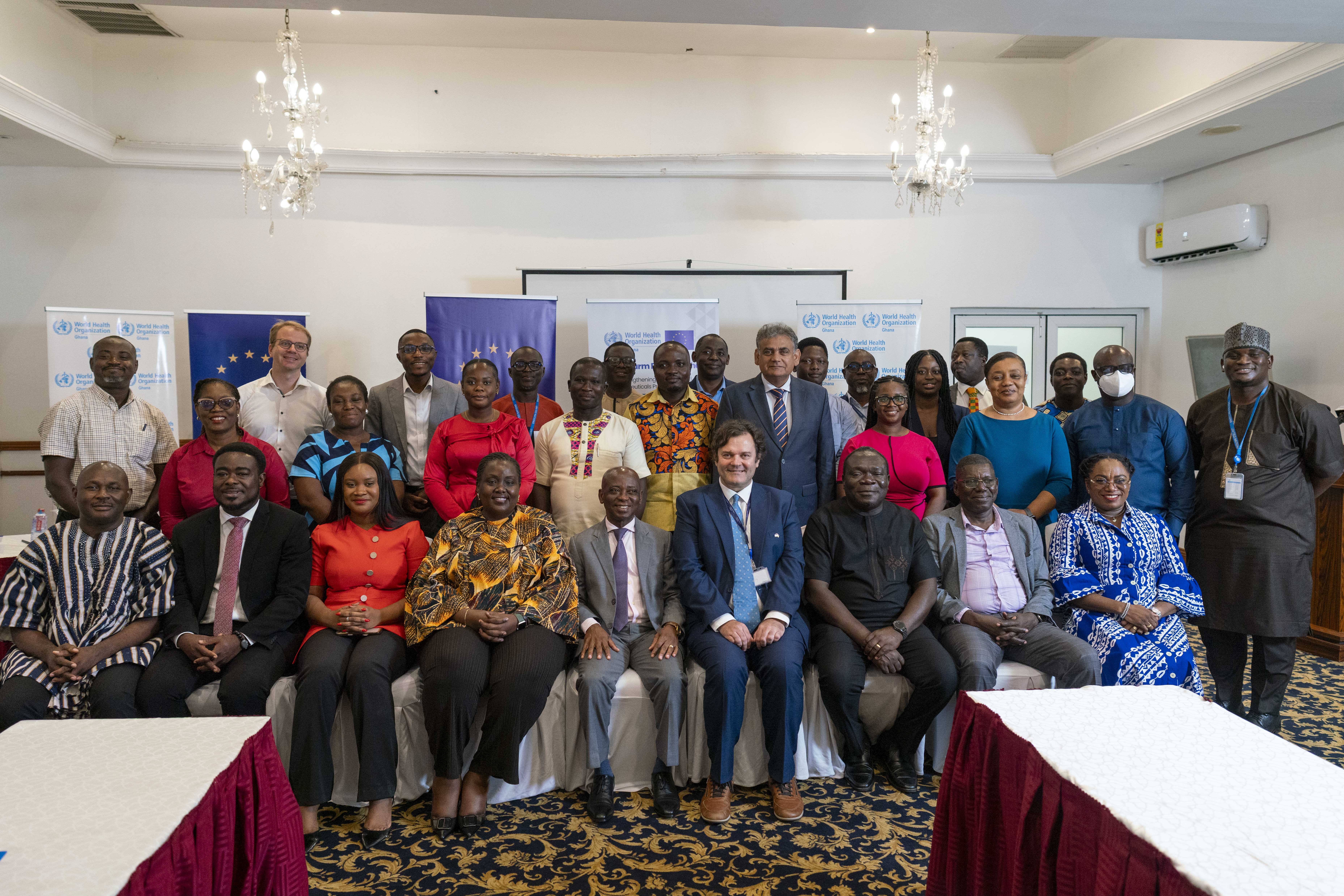
The World Health Organization (WHO) and the European Union (EU) have officially launched a new initiative, Strengthening Vaccines and Pharmaceuticals Production in Ghana (Vax & Pharm – Ghana) Project, to advance Ghana’s local pharmaceutical and vaccine manufacturing capacities. The launch, held in Accra on Thursday, 11 December 2025, marks a significant step toward enhancing equitable access to safe, effective, quality-assured, and affordable essential medicines and vaccines for the Ghanaian population.
Implemented by the Government of Ghana and co-funded by the EU and WHO with EUR 1.1 million over a 24-month period, the project forms part of the ongoing Special Measure on the Team Europe intervention on Manufacturing and Access to Vaccines, medicines and health technologies in Africa (MAV+).
The EU Ambassador to Ghana, H.E. Rune Skinnebach, stated, “Since 2021, Team Europe has expanded its financial support for Ghana’s pharmaceutical and vaccine sector, raising contributions from EUR 3 million—to nearly EUR 50 million to support the creation of enabling environments for pharmaceutical products and health technologies. The EU is pleased to work with the World Health Organization to accelerate and advance universal health coverage in Ghana and boost skills to create jobs”.
WHO Representative to Ghana, Dr. Fiona Braka, emphasized the importance of local production as part of Ghana’s broader health system reforms.
“Building resilient health systems requires strong local capacity to manufacture the medicines and vaccines people depend on. This initiative strengthens Ghana’s journey toward self-reliance and ensures that lifesaving health products are available when and where they are needed”, she said.
The Minister for Health, Hon. Kwabena Mintah Akandoh, underscored the urgency of strengthening Ghana’s pharmaceutical security, stating, “Health security cannot be outsourced. Access to life-saving medicines cannot be left to chance or charity. We must build our own capacity”.
The initiative, which aligns with Ghana’s Universal Health Coverage (UHC) Roadmap (2020–2030), will support national efforts to improve access to essential medical products while fostering the growth of the local pharmaceutical industry. It comes at a critical time as Ghana works towards self-sufficiency in vaccine production, bolstered by the establishment of the National Vaccine Institute (NVI) and the government’s 10-year vaccine manufacturing roadmap.
END
For media inquiries, please contact: Abdul-Rahim Naa Abdul-Lahie Communications Officer World Health Organization Ghana abdullahiea [at] who.int (abdullahiea[at]who[dot]int) +233 (0) 20 196 2393 |
Deborah Smallie LOMOTEY Press and Information Assistant European Union in Ghana Deborah-smallie.LOMOTEY [at] eeas.europa.eu (Deborah-smallie[dot]LOMOTEY[at]eeas[dot]europa[dot]eu) +233 (0) 50 986 1485 |
Strengthening Vaccines and Pharmaceuticals Production in Ghana (Vax & Pharm – Ghana) Project is a 2-year project aimed at supporting Ghana’s pharmaceutical sector towards achieving universal health coverage. By building local capacity to produce essential medicines and vaccines, dependency on imports can be reduced, ensuring timely availability of critical health products for all Ghanaians.
The initiative will focus on three strategic objectives:
1. Strengthening Research and Development (R&D) to facilitate sustainable pharmaceutical and vaccine manufacturing in Ghana.
2. Establishing processes for cGMP (current Good Manufacturing Practice) compliance in partnership with regulators to ensure quality and safety in local production and eligibility for WHO prequalification.
3. Creating an enabling environment for local production of medicines and vaccines, ensuring sustained affordability and accessibility in Ghana and beyond.
The EU’s support is delivered under the Team Europe Initiative on Manufacturing and Access to Vaccines, Medicines, and Health Technologies in Africa (TEI MAV+). The initiative aims to help reduce Ghana’s reliance on imports—currently about 70% of essential medicines—and position the country as a regional hub for pharmaceutical production in West Africa.
Through targeted interventions in policy, regulation, technology transfer, and workforce development, the programme is expected to improve the availability of essential medical products while creating jobs, fostering innovation, and enhancing Ghana’s overall health security.
WHO and the EU will continue working closely with the Government of Ghana and national stakeholders to ensure effective implementation of the initiative and to advance the country’s pathway toward a healthier and more self-reliant future.